viernes, 27 de septiembre de 2019

Podcast #370: Complexity Revisited: Software and Safety

By Bob Rhubart

On October 29, 2018 a Boeing 737 Max aircraft operated by Lion Air in Indonesia crashed shortly after takeoff, killing all 189 passengers and crew. Five months later, on March 10, 2019, a Boeing 737 Max operated by Ethiopian Airlines met an identical fate, crashing after takeoff and killing all 157 people on board.

In both cases, investigators found that the planes were brought down by problems with flight control software. Those problems grounded the entire global fleet of Boeing 737 Max aircraft, and as I’m writing this those planes remain grounded. The ongoing story of the Boeing 737 Max warrants revisiting a program from the Groundbreaker Podcast archives. That program, Combating Complexity: Fad, Fashion, and Failure in Software Development, was originally published on March 21, 2018.

The program was inspired by The Coming Software Apocalypse, an article written by James Somersan for the September 2017 edition of The Atlantic magazine. One of the sources for that article was Chris Newcombe, an architect now with Oracle. Chris is one of the panelists you’ll hear on that original podcast, along with Java Champion Adam Bien, Java Champion and Eventuate Founder Chris Richardson, and Oracle Groundbreaker Ambassador Lucas Jellema, CTO of Amis Services.

The Panelists
(In alphabetical order)

Java Champion Adam BienAdam Bien
Freelancer, Author, Java Champion
Germany

 
"It really depends on the focus or the context. I would say that in enterprise software, code works well. The problem I see is more if you get newer ideas -- how to reshape the existing code quickly."

Oracle ACE Director Lucas JellemaLucas Jellema
CTO/Consulting IT Architect, AMIS
Rotterdam Area, Netherlands

 
"The complexity may not be in the software, but in the translation of the real-world problem or requirement into software."

Chris NewcombeChris Newcombe
Architect, Oracle Bare Metal IaaS Team
 LinkedIn


"If you're talking about control systems, with significant concurrency or affecting real-world equipment, like cars and planes and rockets or large-scale distribution systems, then we still have a way to go to solve the problem of true reliability."


Java Champion Chris RichardsonChris Richardson
Founder, Eventuate. Inc
San Francisco, California
TwitterLinkedIn

 
“How successful are large software developments?  Do they meet requirements on time? Obviously that's a complex issue around project management and people. But what's the success rate?"

Additional Resources
The Coming Software Apocalypse

Oracle Hot Topics: HEAVY "GC CR DISK READ" ON UNDO WITH PQ IN 8 NODES RAC


Bugs

Bug
Product Area
Bug ID
Last Updated
Oracle Database - Enterprise Edition
29774466
Thu, 26 Sep 2019 08:27 GMT-06:00

Knowledge Articles

Knowledge Article
Product Area
Last Updated
Oracle Database Exadata Cloud Machine Oracle Database Cloud Exadata Service Oracle Database Exadata Express Cloud Service Oracle Database Cloud Service Oracle Cloud Infrastructure - Database Service Oracle Cloud Infrastructure Linux OS Oracle Database - Enterprise Edition Oracle Database Cloud Schema Service Oracle Database Backup Service
Wed, 25 Sep 2019 08:54 GMT-06:00

"This message contains information according to the preferences you set in My Oracle Support. To modify your settings or to turn off this automated message, login to My Oracle Support (http://support.oracle.com) and click on 'More' -> 'Settings' -> 'Hot Topics E-mail'" My Oracle Support

martes, 24 de septiembre de 2019

Oracle Survey Finds Investigative Sites Still Frustrated with eClinical Technology

Press Release 

Investigative sites challenged with disjointed technologies that are stunting adoption and hampering industry progress 

Redwood Shores, Calif.—Sep 24, 2019 

Clinical trials are the foundation for getting needed drug and medical treatments to market. However, a new global survey found that disjointed technologies and undue complexity in sharing information and training is stalling outcomes. 

“Sites are overwhelmed with too many solutions and ballooning login credentials,” said Jim Kremidas, executive director, ACRP. “Instead of engaging with patients, an inordinate amount of time is spent learning new systems, completing redundant required training and reentering the same data multiple times. Simultaneously, pharmaceutical companies and CROs are left with a fragmented ecosystem of software, hardware, vendors, and processes that ultimately distracts everyone involved from the goals of clinical research.” 

Agregar leyenda
The survey Impact Assessment of eClinical Technologies and Industry Initiatives on Sites commissioned by Oracle Health Sciences and conducted by the Society for Clinical Research Sites (SCRS) reveals a downward trend in site satisfaction with the current eClinical environment when participating in clinical trials. This is stifling their interest in new industry initiatives and new trial designs such as decentralized trials. 

The survey indicates that while innovation in both clinical trial design and technology meant to improve the site and patient experience is available, investigative sites are concerned about the additional burden these technology changes bring in terms of training, complicated login processes, data duplication, etc. At the same time, sites are concerned about how to strengthen collaboration with sponsors and contract research organizations (CROs), while creating a competitive edge through improved clinical trial performance. 

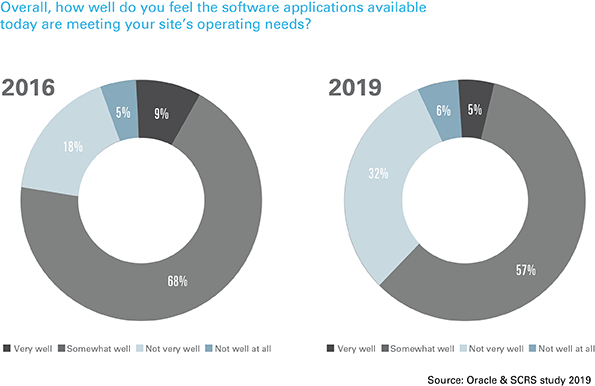
One third of respondents believe today’s eClinical solutions are not meeting their site’s operational needs. This represents a significant increase from 23 percent reported previously in research conducted by the Association of Clinical Research Professionals (ACRP)/CenterWatch in 2016

The survey also revealed that there are many technology options and initiatives to address concerns raised by sites, yet 70 percent of respondents have no plan to use such technology due to high cost and complicated implementation processes. 

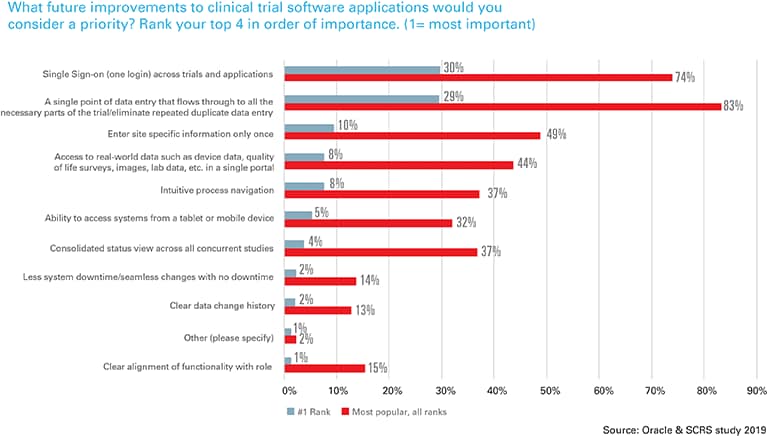
When asked what technology features would help bridge the gap in meeting the site’s operational needs, respondents prioritized a single point of data entry (83 percent) and single sign-on (74 percent) as most important to streamline processes and eliminate redundant data entry. 


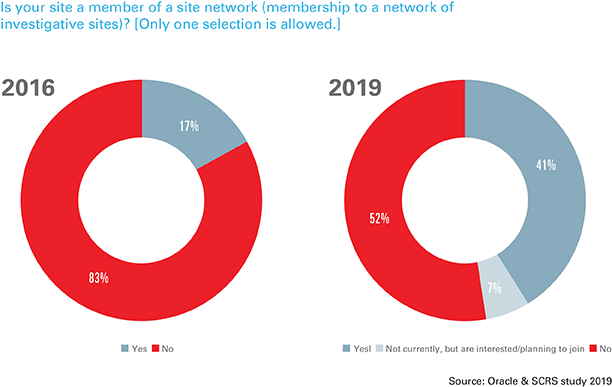
An increase in competition to participate in clinical research is encouraging sites to raise their profiles to increase their chances of being selected for studies. In fact, 48 percent of investigative sites (up 17 percent from the 2016 ACRP/CenterWatch survey) have or are planning to join site networks to gain a competitive edge. 


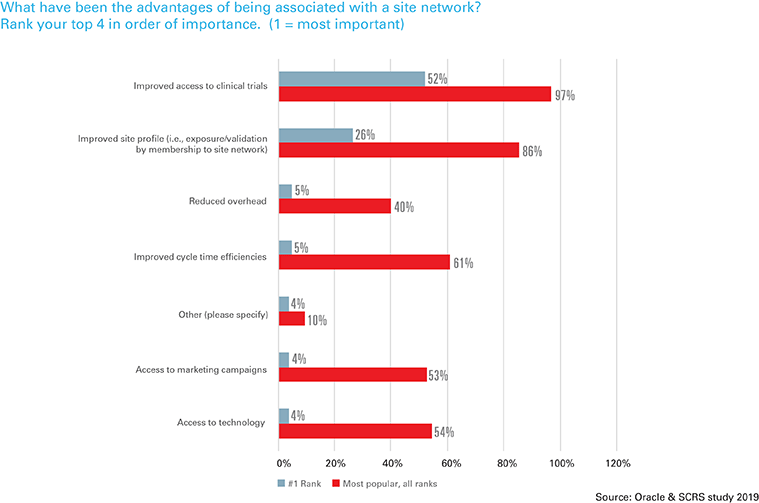
In addition to improved trial access and site profile, respondents cited improved cycle time efficiencies (61 percent) and access to technology (54 percent) as the key benefits of joining site networks. 


“There are significant barriers to entry for new sites, which is concerning given the ‘one and done’ syndrome plaguing the industry, which means a site completes a trial and does not pursue future studies,” said Casey Orvin, president, SCRS. “Site networks can help to reduce some of these burdens by standardizing procedures and enabling new sites to conduct studies, particularly in underrepresented urban areas and population clusters. Sponsors and technology vendors can help by simplifying the technology environment in which sites must work to participate in clinical research.” 
The future of clinical trials 

In addition to exploring how eClinical technologies affect the site experience, the survey sought to understand the impact of patient-centric study design, such as decentralized clinical trials. 

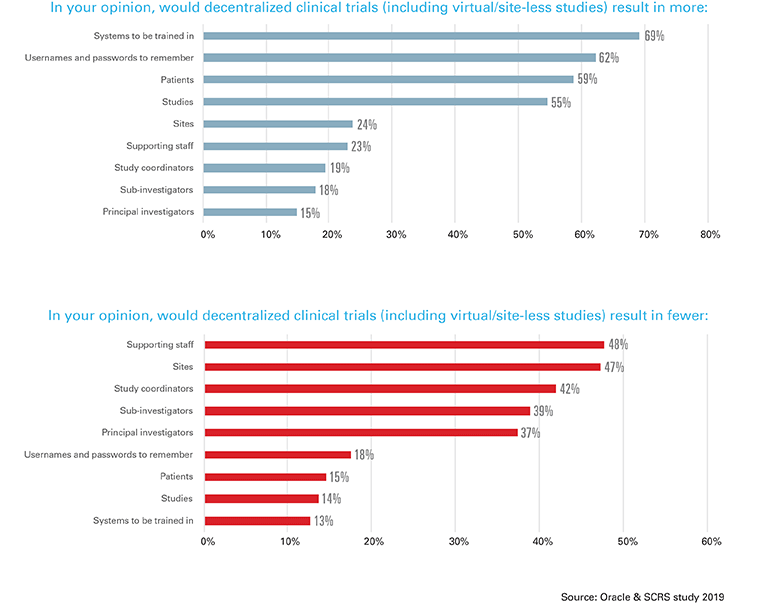
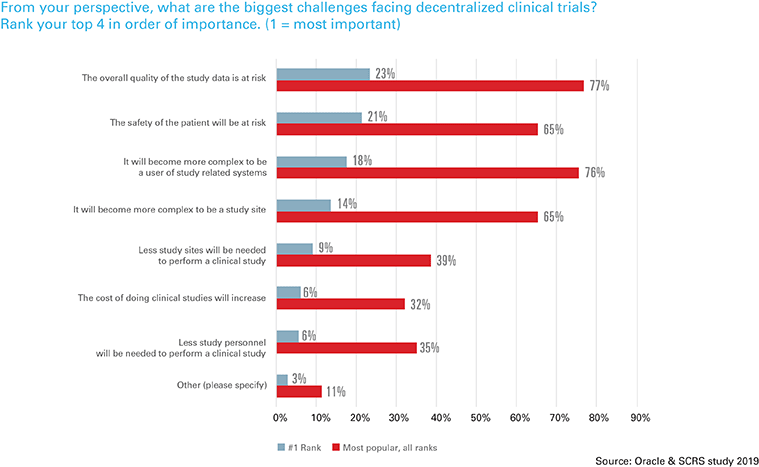
The research probed into the site perspective on decentralized trials, defined as [direct-to-patient, or remote trials where patient data is partly collected offsite, for example in the patient’s home]. While respondents cited greater patient participation (82 percent) and patient access (71 percent) as positive anticipated benefits, they cited more systems to be trained in (69 percent), more usernames and passwords (62 percent), and fewer sites (47 percent) and staff (48 percent) as negative anticipated results. In addition, respondents indicated risk to overall study quality data as the number one concern with decentralized trials. 


“We need to reimagine the way that software is consumed by all stakeholders across the clinical trial continuum. Software needs to be flexible and bring to bear the best functionality needed for clinical trials, regardless of modality,” said Steve Rosenberg, senior vice president and general manager of Oracle Health Sciences. “Sites are dynamic environments, and new technology and industry initiatives are an important complement to their relationship with sponsors and CROs. Understanding the sites’ perspective on these issues and addressing their frustrations is of paramount importance in guiding and sustaining clinical research globally.” 

About the Survey 

The survey was conducted by the Society for Clinical Research Sites (SCRS) and sponsored by Oracle Health Sciences and ran from late April 2019 into June 2019. The largest percentage of responses came from clinical research/study coordinators (47 percent), supporting staff (30 percent, and owner/CEO (13 percent) from investigative sites conducting clinical research. Respondents were from around the globe with 85 percent from North America and 15 percent from the rest of the world.

Download the full research report Impact Assessment of eClinical Technologies and Industry Initiatives on SitesLearn more about Clinical OneRegister now for the live webcast featuring experts from Oracle Health Sciences, SCRS, ACRP and Center for Information & Study Research Participation to understand how a site-centric approach to engagement with investigative sites is fundamental to the goal of increasing efficiencies at all scales in clinical trials on September 24, 2019 at 1:00 p.m. EDT 
Judi Palmer
Oracle
+1 650.784.4119

sábado, 21 de septiembre de 2019

Vast Majority of Consumers Already Plan to Return Holiday Gifts - Generation Z plans to return the most gifts

Press Release 
Vast Majority of Consumers Already Plan to Return Holiday Gifts 
Generation Z plans to return the most gifts 

Redwood Shores, Calif.—Sep 19, 2019 

During the upcoming holiday season 77 percent of consumers surveyed said they plan to return a portion of their gifts, with nearly 20 percent expecting to return more than half of their presents (sorry grandma!). This is both a blessing and a curse for retailers planning for the holiday season. While 32 percent of those polled noted they plan to return gifts via mail, 65 percent intend to return them to the store, giving brick-and-mortar retailers another opportunity to engage customers and boost post-holiday sales. 
“Retailers need to seize the moment when shoppers return gifts. The traffic generated by holiday returns holds significant opportunity for retailers to build better customer profiles and generate new opportunities for engagement by personalizing the returns experience,” said Jeff Warren, vice president of retail solutions management, Oracle Retail. “Preparing for returns is a best practice, leveraging returns intelligence to inform product development and new customer acquisition strategies is next practice retail.” 
The Reality of Returns 

According to survey results of consumers worldwide, Generation Z plans to return over half their presents this year. Returns are simply a fact of life for retailers, but a select few have started to reimagine their returns process to capture essential information and inform other parts of the business and improve customer satisfaction. When a consumer visits a store to return a purchase, that customer comes with a history and therefore opportunity. Well-informed store associates, with the right technology, are key to identifying next best offers to save the sale or upsell at the point of service, and positively influence essential key performance indicators (KPIs), like net promoter score (NPS). Arming associates with technology that provides customer profile data and suggestions aligned with availability of inventory and promotions is crucial to successful execution. The right technology can also reinforce important procedures and mitigate the risk of loss which is another cringe-worthy albeit stark reality of the holiday season. 
In-Store Holds Its Stance 

Despite the rhetoric around store traffic slowing, in-store is still the preferred way to shop. According to the survey of consumers worldwide, 75 percent noted they will shop in-store and bring purchases home compared to 55 percent who said they will shop online and ship to their home. For many, in-store is still the most direct way to ensure that ‘must-have’ gifts will be in hand during that critical holiday moment. 
Shipping Preferences Getting More Complex 

According to the survey, while Generation X (ages 35-54) led the way in shopping online and shipping to home at 57 percent, baby boomers (ages 55+) were a close second at 56 percent and actually topped both millennials (ages 25-34) at 53 percent and Generation Z (ages 18-24) at 46 percent in embracing home delivery. Generation Z and millennials also demonstrated a stronger desire to pick up the gifts they ordered online in the store, with 25 and 30 percent respectively stating they head to the stores to collect purchases, while only 14 percent of baby boomers opted for this approach. 

Among consumers who choose to ship rather than shop in-store, millennials are sending 33 percent of purchases to locations other than their home, with many instead shipping to work (18 percent) or to pick up lockers (15 percent). Baby boomers, who were the second most-likely generation to ship to their homes, were by far the least likely (13 percent) to utilize an alternate location for online purchases. 

The survey, which was independently conducted in 2019 by Savanta, polled 15,800 global consumers in the US, EMEA, LATAM, and JAPAC. 

Contact Info 
Carolin Bachmann
Oracle
+1.650.506.1352

martes, 17 de septiembre de 2019

Oracle and Microsoft Expand Cloud Partnership to Boost Workplace Productivity

Press Release 
Integration of Oracle Digital Assistant with Microsoft Teams gives Microsoft 365 customers access to Oracle Cloud Applications through conversational AI 

ORACLE OPENWORLD, San Francisco, Calif.—Sep 17, 2019 

Building on Oracle and Microsoft’s cloud interoperability partnership, Oracle today announced the availability of an integration between Oracle Digital Assistant and Microsoft Teams. Enterprise customers can now access Oracle Cloud Applications through an AI-powered voice experience in Teams. 

“Using Oracle Digital Assistant, business users can simply and conversationally interact with business applications directly from their Microsoft Teams interface just as they would collaborate with their fellow employees or other productivity tools,” said Suhas Uliyar, vice president, AI and Digital Assistant, Oracle. “Completing daily work tasks becomes much more efficient as the AI-trained conversational access doesn’t require additional employee training on different applications. This is yet another way we are enabling customers to run mission-critical enterprise workloads across Microsoft 365 and Oracle Cloud.” 

Once Oracle Digital Assistant is enabled from the Teams App Store, users can query Oracle Cloud Applications, such as CX and HCM, through a bot conversation. Skills from Oracle Digital Assistant are auto provisioned and auto configured, tapping into the richness of the Teams experience. “Together, Oracle Digital Assistant and Teams enable our customers to transform existing workflows and save time,” said Bhrighu Sareen, general manager, Microsoft Teams Platform. “This integration reduces context change for people since it eliminates the need to switch between applications, enabling them to complete tasks like viewing a sales pipeline in Oracle CX without leaving Teams.” 

Today, the integration of Oracle Digital Assistant and Teams provides customers with a frictionless work environment to boost productivity and faster decision making. In the future, out-of-the-box skills or chatbots for Oracle ERP Cloud, Oracle HCM Cloud and Oracle CX Cloud are planned to be available in Teams via the Oracle Digital Assistant. These pre-built features can enable employee self-service for scenarios spanning sales, project management, expenses, productivity, time and absence management, compensation and benefits, and recruiting. 

“We’ve been working closely with our partner IntraSee to create a HR digital assistant for our global employee base and Oracle Digital Assistant was the natural choice for us because of its ability to securely operate in our hybrid cloud infrastructure,” said Mark Burgess, senior director, HR Technology Solutions, Honeywell. “Our aim is to have it be the preferred method to get questions answered 24x7, access to policies and an amazing end-to-end approach for completing transactions with more speed and accuracy. We knew we wanted our HR digital assistant to be available where employees spend their time online, and an integration with Teams was therefore essential. Our vision is to have it become to employees what J.A.R.V.I.S. is to Iron Man.” 

“We are excited to hear that Oracle Digital Assistant will support Teams,” said Sayan Ray, vice president, IT, SRF Ltd. “We’ve been using Oracle Digital Assistant to deliver conversational interfaces to our backend systems with great success. We also use Teams to collaborate so this partnership will help take Oracle Digital Assistant implementation to new levels in productivity gains.” 

For more information on Oracle Digital Assistant for Teams, please sign up for private preview today


Connect with Oracle Mobile Cloud on Twitter, LinkedIn and via the Oracle Mobile Blog

Contact Info 
Carolin Bachmann
Oracle
+1.650.506.1352

Oracle introduces natural voice conversations to Digital Assistant and enhances deep learning semantic parser to handle complex linguistic constructs

Press Release 
Oracle Unveils AI-Voice for the Enterprise 
 ORACLE OPENWORLD, San Francisco, Calif.—Sep 17, 2019 

Oracle today announced availability of its AI-trained voice with Oracle Digital Assistant. Now, enterprise customers can use voice commands to communicate with their enterprise applications to drive desired actions and outcomes, enriching the user experience with conversational AI, simplifying interactions and improving productivity. 

“Enterprises are demanding an AI-powered voice assistant that understands their specific vocabulary and enables naturally expressive interactions for its users,” said Suhas Uliyar, vice president, AI and Digital Assistant, Oracle. “Most of all though, enterprises value a highly secure AI-powered voice assistant that stores their business’ sensitive data in Oracle’s second generation cloud infrastructure.” 

Built on Oracle’s next-generation infrastructure, Oracle Digital Assistant applies AI with deep semantic parsing for natural language processing (NLP), natural language understanding (NLU) and custom machine learning (ML) algorithms. This combination allows Oracle Digital Assistant to understand a user’s natural conversation, derive intent, produce compositional logical forms, and identify and learn user behavior patterns in order to proactively take action on behalf of the user. A no-code tool that allows enterprises to build conversational experiences, Oracle Digital Assistant can also integrate with human agent work-flows and business processes without any coding required. 

Oracle’s intelligent voice assistant for the enterprise brings conversational AI to new applications by analyzing enterprise-specific and domain-specific vocabulary on which open and consumer-oriented domain models are not trained on. Oracle Digital Assistant, the only enterprise digital assistant on the market today, makes voice and user interactions more expressive by processing complex queries and deriving intelligence from all available enterprise applications, such as ERP, CRM and HR systems to respond in the context to the request made. 

The NLP engines that power today’s traditional messaging-based channels lack the ability to handle highly expressive sentences. Voice interactions, however, enable expressive conversations which require NLP engines to manage much more complex constructs. Linguistic constructs like relative clauses, comparatives, superlatives, negation, anaphora, ordinals, cardinals, superlatives, ellipsis, quantifiers and conjunctions now need to be processed by the NLP engines that require more sophistication than the simple intent classification and slot-filling engines available today. 

Oracle Digital Assistant NLP now comes with a semantic parser that understands these complex linguistic constructions and produces compositional logical forms that go beyond slot-filling. A sales key account manager can, for example, use Oracle Digital Assistant to schedule a lunch meeting with the Key Account Director or “KAD” and locate the most convenient parking garage for the meeting. Asking the Oracle Digital Assistant to “Find the address of the closest parking garage near the Japanese restaurant by Japantown’s Peace Pagoda” will return directions to the nearest parking garage not the Japanese restaurant. In addition, the acronym “KAD” is a contextual and enterprise-specific term which consumer-grade voice systems typically misinterpret. Oracle Digital Assistant is uniquely able to distinguish enterprise- and domain-specific vocabulary that various HCM, ERP and CX systems use regularly. 

Oracle Digital Assistant is pre-built with AI-trained enterprise skills across ERP, SCM, HCM and CX and can connect to multiple back-end systems simultaneously to orchestrate user interactions across various application skills. With these plug-and-play skills, line-of-business users only have to interface with one digital assistant that can source the right information from employee directories, expense management systems or an assortment of other enterprise applications, including Oracle Cloud Application offerings. Oracle Digital Assistant can also be deployed to popular conversational interfaces, such as Microsoft Teams, Slack, Facebook Messenger, WeChat and across voice interfaces like Siri and Alexa. 
Customer Spotlight 

Customers in various industries showcase the power of Oracle Digital Assistant. 

“We consider voice powered assistants to be a game-changing element with our customers,” said Kumar Thakur, principal architect, Exelon Utilities. “No apps to download or launch, just simply talk to the Oracle Digital Assistant, just as if you’re talking to the help desk and get your problems addressed automatically. When you scale that to millions of customers, the savings are easy to see.” 

“Deploying the chatbot is going to make significant savings this year,” said Chris Ashworth, CIO, Hermes. “Oracle Digital Assistant now handles 38 percent of our customer queries providing us with significant cost savings and an increase in our customer satisfaction levels.” 

“We will be using Oracle’s new voice recognition technology to ‘understand’ the beekeeper’s spoken words,” said Sabiha Malik, founder and executive president, The World Bee Project CIC. “We have developed ‘The World Bee Project Bee Assistant’ in collaboration with Oracle. The new voice recognition technology does radically improve the ease and accuracy of hive inspections as beekeepers are guided by voice responses and can effortlessly record the data from their inspections. Thanks to this contribution from Oracle, we will be able to use our ‘World Bee Project Bee Assistant’ to help beekeepers and bee-keeping farmers worldwide to develop best beekeeping practices to improve the health of their bee colonies by better understanding the relationships between bee health, hive conditions and hive environments.” 

“Oracle Digital Assistant has given us tremendous results by helping to scale up our service delivery to prospective students,” said Catherine Cherry, director, Prospect Management, University of Adelaide. “Our International Eligibility chatbot has enabled us to improve our student experience for international students. With this brand-new service, we are able to answer the most critical question prospects will ask us – ‘am I eligible?’ – 24/7 around the globe. In terms of business outcomes, the Eligibility chatbot allows us to extend our workforce and deal with higher enquiry volumes. It is also bringing us new leads from new geographic markets and leads that have a qualification level that would not be possible to gather any other way at the speed and scale of the chatbot. The new sophisticated voice capabilities of Oracle Digital Assistant offer us the ability to extend this new service to our second most used channel – phone – which simply would not be possible for us without a virtual agent.” 
Industry Accolade 

Oracle has been recognized by industry analyst reports for its multi-channel and digital experience development platform. 


Connect with Oracle Mobile Cloud on Twitter, LinkedIn and via the Oracle Mobile Blog

Contact Info 
Carolin Bachmann
Oracle
+1.650.506.1352

Oracle and VMware Partner to Support Customers’ Hybrid Cloud Strategies

Press Release 

New Oracle Cloud VMware Solution will Enable Customers to Run VMware Workloads on Oracle Cloud
Oracle to Offer Technical Support for Oracle Products Running on VMware Virtualized Environments 

ORACLE OPENWORLD, San Francisco, Calif.—Sep 16, 2019 


Today, Oracle (NYSE: ORCL) and VMware, Inc. (NYSE: VMW) announced an expanded partnership to help customers leverage the companies’ enterprise software and cloud solutions to make the move to the cloud. Under this new partnership, customers will be able to support their hybrid cloud strategies by running VMware Cloud Foundation on Oracle Cloud Infrastructure. With this new solution, customers will be able to easily migrate VMware vSphere workloads to Oracle’s Generation 2 Cloud Infrastructure and take advantage of consistent infrastructure and operations. As a part of this partnership, Oracle will also provide technical support for Oracle software running in VMware environments both in customer on-premise data centers and Oracle-certified cloud environments. 

“As more of our customers make the move to cloud, they’re looking for a superior VMware experience. We are excited that Oracle Cloud customers will be able to run VMware workloads in Oracle Cloud and retain VMware administrative access,” said Don Johnson, executive vice president, Oracle Cloud Infrastructure. “This is made possible by Layer 2 networking in the cloud and our bare metal service. Customers will be able to extend existing VMware investments, processes, and tools while benefitting from the security and performance of Oracle Cloud Infrastructure.” 

“VMware is delighted that for the first time, Oracle will officially offer technical support for Oracle products running on VMware. This is a win-win for customers,” said Sanjay Poonen, chief operating officer, customer operations, VMware. “We’re also happy to welcome Oracle to the VMware Cloud Provider Program, which will allow them to migrate and manage workloads running on VMware Cloud Foundation in Oracle Cloud Infrastructure.” 
Running VMware workloads in Oracle Cloud 

With this announcement, Oracle becomes a partner in the VMware Cloud Provider Program and Oracle Cloud VMware Solution will be sold by Oracle and its partners. The solution will be based on VMware Cloud Foundation and will deliver a full stack software-defined data center (SDDC) including VMware vSphere, NSX, and vSAN. Through consistent infrastructure and operations, customers will be able to migrate and modernize applications, seamlessly moving workloads between on-premise environments and Oracle Cloud. 

Customers will be able to easily use Oracle services, such as Oracle Autonomous Database, Oracle Exadata Cloud Service and Oracle Database Cloud, which run in the same cloud data centers, on the same networks, with a consistent portal and APIs. Customers will also be able to leverage Oracle’s rapidly expanding footprint of global regions to scale globally without needing to establish their own data centers. Oracle will provide administrative access to the underlying physical servers, enabling a level of control previously only possible on premise, and customers will be able to use VMware vCenter to manage both their on-premise clusters and Oracle Cloud-based SDDCs through a single pane of glass. Oracle will also provide first line technical support for this solution. 

To learn more about the offering visit: https://www.oracle.com/cloud/VMware
Customer Support for Oracle on VMware 

Additionally, customers will have access to Oracle technical support for Oracle products running on VMware environments. When the Oracle support statement is updated, it will enable customers to achieve quicker time to resolution of issues. Oracle will support customers with active support contracts running supported versions of Oracle products in Oracle supported computing environments.

Customer Commentary 
“Oracle and VMware are technology providers that we depend on to run our organization successfully. As a longtime customer of both companies, we are pleased that this partnership demonstrates—with decisive clarity—that Oracle products are indeed supported. This gives us even greater confidence that we have strategic partners that are working together in our best interest to help ensure that in the event something goes wrong, we are fully supported and will face minimal disruption in our operations.”—Dan Young, Chief Data Architect and Manager of Enterprise Database Administration, Indiana University 
“We run multiple versions of VMware on premise. Oracle will give us the same ability in the cloud, allowing us to meet our corporate IT policies. This is the level of control necessary to move our mission-critical workloads to the cloud.”—Munish Mittal, CIO & Group Head-IT - HDFC Bank 
Contact Info 
Danielle Tarp
Oracle
+1.650.506.2905

Oracle Ups the Ante in Cloud with World’s First Autonomous Operating System

Press Release 

Oracle extends autonomous capabilities to Linux operating system 

ORACLE OPENWORLD, San Francisco, Calif.—Sep 16, 2019 

Oracle today marked a major milestone in the company’s autonomous strategy with the availability of Oracle Autonomous Linux. Oracle Autonomous Linux, along with the new Oracle OS Management Service, is the first and only autonomous operating environment that eliminates complexity and human error to deliver unprecedented cost savings, security, and availability for customers. 

Keeping systems patched and secure is one of the biggest ongoing challenges faced by IT today. Tasks can be tedious and error prone, and extremely difficult to manage in large-scale cloud environments. With Oracle Autonomous Linux, customers can rely on autonomous capabilities to help ensure their systems are secure and highly available to help prevent cyberattacks. 

“Oracle Autonomous Linux builds on Oracle’s proven history of delivering Linux with extreme performance, reliability, and security to run the most demanding enterprise applications,” said Wim Coekaerts, senior vice president of operating systems and virtualization engineering, Oracle. “Today we are taking the next step in our autonomous strategy with Oracle Autonomous Linux, providing a rich set of capabilities to help our customers significantly improve reliability and protect their systems from cyberthreats.” 
Introducing Oracle OS Management Service 

Along with Oracle Autonomous Linux, Oracle introduced Oracle OS Management Service, a highly available Oracle Cloud Infrastructure component that delivers control and visibility over systems whether they run Autonomous Linux, Linux, or Windows. Combined with resource governance policies, OS Management Service, via the Oracle Cloud Infrastructure console or APIs, also enables users to automate capabilities that will execute common management tasks for Linux systems, including patch and package management, security and compliance reporting, and configuration management. It can be further automated with other Oracle Cloud Infrastructure services like auto-scaling as workloads need to grow or shrink to meet elastic demand. 

Oracle Autonomous Linux, in conjunction with Oracle OS Management Service, uses advanced machine learning and autonomous capabilities to deliver unprecedented cost savings, security, and availability and frees up critical IT resources to tackle more strategic initiatives. 

· Eliminate manual OS management—World’s first autonomous operating system in the cloud to deliver automated patching, updates, and tuning without human intervention. Based on a preconfigured Oracle Linux image; automated daily package updates; enhanced OS parameter tuning and OS diagnostics gathering. 

· Deliver automatic, in-depth protection at all levels—100 percent hands-off automatic security updates daily to the Linux kernel and key user space libraries. This requires no downtime along with protection from both external attacks and malicious internal users. Known Exploit Detection provides automated alerts if anyone attempts to exploit a vulnerability that has been patched by Oracle. 

· Provide always-on availability—Includes automated patching and upgrades while the system is running, eliminating unnecessary downtime for users and the system. 


Oracle Autonomous Linux and Oracle OS Management Services are included with Oracle Premier Support at no extra charge with Oracle Cloud Infrastructure compute services. Combined with Oracle Cloud Infrastructure’s other cost advantages, most Linux workload customers can expect to have 30-50 percent TCO savings versus both on-premise and other cloud vendors over five years. 

“Adding autonomous capabilities to the operating system layer, with future plans to expand beyond infrastructure software, goes straight after the OpEx challenges nearly all customers face today,” said Al Gillen, Group VP, Software Development and Open Source, IDC. “This capability effectively turns Oracle Linux into a service, freeing customers to focus their IT resources on application and user experience, where they can deliver true competitive differentiation.” 

Oracle Linux has a long history of leadership, beginning in 1998 when Oracle introduced the first commercial relational database for Linux. With Oracle Autonomous Linux the company takes another major step in Linux innovation. Oracle Autonomous Linux is based on the proven Oracle Linux operating environment to deliver extreme performance, reliability, and security to run the most demanding enterprise applications. Oracle Linux, which powers Oracle Cloud and Oracle Engineered Systems, is used extensively by tens of thousands of customers globally, and thousands of ISVs certify their software to run on Oracle Linux. 

Follow Oracle Linux on blog, Twitter, Facebook

Oracle Cloud Automates Security for Critical Workloads

Press Release 

Augments security portfolio with cloud services designed to automatically detect, hunt, and kill cyber threats

ORACLE OPENWORLD, San Francisco, Calif.—Sep 16, 2019

Oracle today announced that it is expanding its security portfolio with new cloud services designed to automatically help protect cloud workloads and data from risks posed by misconfigurations and cyber threats. The three new cloud services, including Oracle Data Safe, Oracle Cloud Guard and Oracle Maximum Security Zones provide centralized security configuration and posture management, as well as automated enforcement of security practices.
Together with Oracle Data Safe, Cloud Guard and Maximum Security Zones, customers can better protect their critical workloads. These intelligent systems operate in the background enforcing security practices, gathering telemetry from across the cloud environment, and surfacing misconfigurations, anomalous behavior and risks to respond to through automated means. With the new capabilities, customers of Oracle Cloud will not bear the burden of designing secure architectures from scratch and will be better protected from the consequences of misconfigurations than they are in other cloud environments today. 

“Data is your most valuable asset, and hackers will exploit any weakness, whether in databases, their users, or their infrastructure,” said Vipin Samar, senior vice president, Database Security, Oracle. “We created Oracle Data Safe to help organizations secure their data in the cloud, irrespective of their size or security expertise.”

Cloud enables organizations to better address a cyber threat landscape that continues to increase in size and complexity. In the 2019 Oracle KPMG Cloud Threat Report, 72 percent of organizations responded that security in the cloud is better than what they can achieve on their own. Today, Oracle is introducing security capabilities that collectively automate security processes at all layers of the cloud stack from the infrastructure to the application layer.

“We are seeing enterprises make too many configuration errors when setting up their cloud services. This is putting their business at risk needlessly,” said Maxine Holt, research director, Ovum. “By allowing for pre-set templated configuration of their cloud services, enterprises will be better protected knowing that the right security services are not only turned on, but more closely aligned to their business needs and policies.”
Oracle Data Safe Automates Protection of Customer Data

Oracle Data Safe is a unified control center for automating database security and improving visibility into security issues with data, users, and configuration. Oracle Data Safe provides vital security controls, including monitoring database activity, discovering sensitive data, and masking databases to help minimize security risk. Built from the ground up, leveraging Oracle’s decades of database security experience, Oracle Data Safe helps customers protect their Oracle Database Cloud services, including Oracle Autonomous Database. It complements the security features already in Oracle Autonomous Database, such as always-on encryption and self-patching. Available now on Oracle Cloud Infrastructure, Oracle Data Safe is included with all Oracle Database Cloud services. For more information, read this Oracle blog.
Oracle Cloud Guard Delivers Visibility and Monitoring Across Cloud Environments

Oracle Cloud Guard is a unified security solution that provides a global and centralized approach to the protection of all of a customers’ assets. It works to analyze data, detect threats and misconfigurations automatically, then hunt down and kill those security threats without requiring human oversight. Oracle Cloud Guard continuously collects data from every part of the infrastructure and application stack, including audit logs, Oracle Data Safe, Oracle OS Management Service, as well as third-party products. Oracle Cloud Guard proactively detects and stops anomalous activity it identifies, shutting down a malicious instance automatically, and proactively revoking user permissions when it detects anomalous user behavior. 
Maximum Security Zones Deliver the Highest Levels of Security

Oracle Cloud Maximum Security Zones comprises an enclave within a customer’s environment where security is mandatory and always on. It provides a combination of automated preventative and detective means to enforce security controls and practices to customer defined configurations of Oracle Cloud resources. Customers effectively lock down resources to known secure configurations, automatically prevent configuration changes, and continuously monitor and block anomalous activities. Maximum Security Zones are enforced through the automated activation of all relevant and preconfigured security services, including application security and the new Cloud Guard. 


Follow Oracle Security via Twitter, Facebook and Blogs

Contact Info
Nicole Maloney
Oracle
+1.650.506.0806

Oracle Delivers Choice of Deployment for its Next-Generation Cloud

Press Release 

Company rolls out Gen 2 Exadata Cloud at Customer, previews Autonomous Database Cloud at Customer 

ORACLE OPENWORLD, San Francisco, Calif.—Sep 16, 2019 

Oracle today announced the availability of its Generation 2 Exadata Cloud at Customer service and previewed Oracle Autonomous Database Cloud at Customer. Oracle Cloud at Customer enables organizations to get all the benefits of Oracle Cloud Database delivered securely on premise in their own data centers. 

Introduced three years ago, Oracle Exadata Cloud at Customer is designed to help organizations easily move business critical database workloads to a cloud architecture and remove the obstacles to cloud adoption. With Gen 2 Exadata Cloud at Customer, Oracle continues to deliver on its pioneering vision of providing database cloud services on customers’ premises for those who cannot move data to the public cloud due to business, regulatory, or network latency requirements. 

“Over 25 percent of the largest companies in the world have already adopted Exadata Cloud,” said Juan Loaiza, executive vice president, mission-critical database technologies, Oracle. “Gen 2 Exadata Cloud at Customer delivers the Exadata Public Cloud management model, financial model, hardware, APIs, and UI in customers’ data centers to overcome all obstacles to moving to a cloud architecture.” 

With Gen 2 Exadata Cloud at Customer, Oracle delivers an enterprise-scale database cloud service with significantly improved resiliency and automation, simplified deployment, and reduced costs compared to the previous generation. Gen 2 Exadata Cloud at Customer is based on the recently announced Oracle Exadata X8, which delivers industry-leading performance and availability, as well as a broad range of exclusive capabilities based on modern machine learning. In addition, Gen 2 Exadata Cloud at Customer leverages a modern Cloud Control Plane that is deployed in the nearest Oracle Public Cloud region. This simplifies cloud management while reducing space, power and cooling requirements. Customers can now use the same Gen 2 Oracle Cloud Web Interfaces and APIs to manage Exadata Cloud Service and Exadata Cloud at Customer. 

“Gen 2 Oracle Exadata Cloud at Customer is ideal for IT organizations that want a public cloud experience in their own data centers—not just managed hardware, but a full-blown public cloud system with the same hardware, software, control plane and services as the public cloud,” said Carl Olofson, Research Vice President, Data Management Software, IDC. “Our research shows that organizations realized average benefits worth $1.93 million per organization per year, a 356-percent ROI and a breakeven point of six months when using Exadata Cloud at Customer.* In IDC’s opinion, customers seeking a proven, production-hardened on-premises cloud services solution should evaluate Oracle today.” 

*Source: IDC White Paper, sponsored by Oracle, Exadata Cloud at Customer Optimizes Database Performance, Reduces Operational Costs, and Contributes to Better Business Results, September 2019. IDC’s standard ROI methodology was utilized for this project. This methodology is based on gathering data from eight interviews with organizations using the first generation of Oracle’s cloud-based service that had experience with or knowledge about its benefits and cost. 

Follow Oracle Exadata via Blog and Twitter

Contact Info 
Nicole Maloney
Oracle
+1.650.506.0806

Victoria Brown
Oracle
+1.650.850.2009

Oracle Offers Always Free Autonomous Database and Cloud Infrastructure

Press Release 
New Always Free services enable developers and students to learn, build and get hands-on experience with Oracle Cloud for unlimited time 

ORACLE OPENWORLD, San Francisco, Calif.—Sep 16, 2019 

Oracle today announced Oracle Cloud Free Tier, including new Always Free services for anyone to try the world’s first self-driving database and Oracle Cloud Infrastructure for an unlimited time. Now, organizations large and small, developers, students, and educators can build, learn, and explore the full functionality of Oracle Autonomous Database and Oracle Cloud Infrastructure, including Compute VMs, Block and Object Storage, and Load Balancer—all of the essentials for developers to build complete applications on Oracle Cloud. 
While other hyperscale cloud vendors provide a free 12-month trial of their relational database and then start charging, Oracle’s Always Free Autonomous Database remains free for as long as it is used. Oracle also offers more compute and storage as Always Free services than its competitors do with their free trials. Users can upgrade easily to get more instances, larger instances, and additional services. Always Free services are available in all regions of the world and are available to anyone, including those with paid accounts using Universal Credit pricing and new Free Tier accounts. 

“We are thrilled to offer Always Free Oracle Autonomous Database and Oracle Cloud Infrastructure,” said Andrew Mendelsohn, executive vice president, Database Server Technologies, Oracle. “This enables the next generation of developers, analysts, and data scientists to learn the latest database and machine learning technologies for developing powerful data-driven applications and analytics on the cloud.” 

The new program enables developers to build applications using any language and framework on top of Oracle Cloud Infrastructure and Autonomous Database. They can get started quickly without waiting for IT to provision and learn new technologies such as artificial intelligence and machine learning. Enterprises can use Free Tier to prototype, prove out new technologies, and do testing before moving production workloads to the cloud. They can sample robust enterprise infrastructure capabilities like load balancing and storage cloning. Additionally, students can learn how to use the latest technologies and become better prepared for their careers. 

Oracle also provides a rich set of free developer tools so developers can build and deploy new data-driven applications faster on Oracle Autonomous Database. Developer tools include Oracle Application Express (APEX) for low-code Web application development, SQL Developer Web for user interaction with the database, Machine Learning Notebooks, REST interfaces for easy access and publishing of database data, and drivers for all popular programming languages. The Oracle Cloud Developer Image includes the latest tools, choice of development languages, OCI Software Development Kits (SDKs), and database connectors. Oracle Cloud Infrastructure resources can all be operated by console, REST APIs, and SDKs, or automated with Terraform

As part of today’s news, Oracle also will be providing educators and students with the Oracle Cloud Free Tier through Oracle Academy, Oracle’s global, philanthropic educational program. Starting in early 2020, Oracle Academy Institutional members will enjoy easy signup, and educators will be able to create free accounts for their students. Additionally, Oracle Academy is developing academic curriculum on Oracle Autonomous Database and Oracle APEX. 

Oracle’s Free Tier program has two components: 
· Always Free services, which provide access to Oracle Cloud services for an unlimited time
· Free Trial, which provides $300 in credits for 30 days to try additional services and larger shapes 
The new Always Free program includes the essentials users need to build and test applications in the cloud: Oracle Autonomous Database, Compute VMs, Block Volumes, Object and Archive Storage, and Load Balancer. Specifications include: 
· 2 Autonomous Databases (Autonomous Data Warehouse or Autonomous Transaction Processing), each with 1 OCPU and 20 GB storage
· 2 Compute VMs, each with 1/8 OCPU and 1 GB memory
· 2 Block Volumes, 100 GB total, with up to 5 free backups
· 10 GB Object Storage, 10 GB Archive Storage, and 50,000/month API requests
· 1 Load Balancer, 10 Mbps bandwidth
· 10 TB/month Outbound Data Transfer
· 500 million ingestion Datapoints and 1 billion Datapoints for Monitoring Service
· 1 million Notification delivery options per month and 1000 emails per month 
Oracle has one of the world’s most popular databases, especially for mission-critical applications. Oracle Autonomous Database and all of Oracle’s cloud services and Oracle Applications run best on Oracle Cloud Infrastructure. Oracle Autonomous Database, the industry’s first and only self-driving database, was designed to run on Oracle’s Gen 2 infrastructure, and just about every database and workload run better in terms of performance, network, and security on Oracle Cloud Infrastructure. 

The first of its kind, Oracle Autonomous Database uses ground-breaking machine learning to provide self-driving, self-repairing, and self-securing capabilities. As such, it automates key management and security processes in database systems like patching, tuning and upgrading, all while keeping the critical infrastructure constantly running for a modern cloud experience. Running on Oracle Cloud Infrastructure, 

Oracle Autonomous Database delivers significantly lower cost than alternatives. 


Contact Info 

Nicole Maloney
Oracle
+1.650.506.0806

Oracle and Intel Collaborate on Optane DC Persistent Memory Performance Breakthroughs in Next Generation Oracle Exadata X8M

Press Release 

World’s first and only shared persistent memory system optimized for Oracle Database 

ORACLE OPENWORLD, San Francisco, Calif.—Sep 16, 2019 

Intel Corporation and Oracle today announced that Oracle is incorporating the high performance capabilities of Intel® Optane™ DC Persistent Memory into its next-generation Exadata platform, Oracle Exadata X8M. Exadata powers Oracle Autonomous Database, Oracle Cloud Applications, and high-performance database infrastructure at most of the world’s leading banks, telecoms, and retailers. 

Built using industry-standard Intel® 2nd generation Xeon® Scalable processors, Intel® Optane™ DC Persistent Memory, and 100 gigabit RoCE networking, Oracle Exadata X8M is designed to support today’s demanding Online Transaction Processing (OLTP), analytics, and mixed workload database requirements, as well as database consolidation and in-database machine learning. This first-of-its-kind integration, is designed to provide customers with superior performance for latency-sensitive activities such as high-frequency stock trading, IoT data processing, real-time fraud and intrusion detection, financial trading and applications requiring real-time human interactions. 

“At Intel we’re focused on delivering a platform foundation to enable customers to unleash the value from data. The integration of Intel’s 2nd generation Xeon Scalable processors and Optane DC Persistent Memory across Oracle’s Exadata X8M products is an extension of our long-term partnership to deliver breakthrough solutions for enterprises across the globe,” said Navin Shenoy, Executive Vice President and General Manager, Data Center Group at Intel Corporation. “By enabling faster analytics and enhanced response times our customers are experiencing what’s possible with Optane DC Persistent Memory.” 

“Our collaboration with Intel sets a new industry standard for supporting databases with the highest performance and availability,” said Juan Loaiza, executive vice president, Mission-Critical Database Technologies, Oracle. “Oracle and Intel have integrated cutting-edge persistent memory technologies into the leading enterprise database machine to deliver real-time access to the most mission-critical data. This transcends the boundaries of conventional shared storage systems and servers that simply cannot keep pace with this level of innovation.” 


Intel Optane DC Persistent Memory is a groundbreaking innovation in the memory-storage hierarchy that combines near-DRAM performance with the data persistence of storage. Enabled on 2nd generation Intel Xeon Scalable processors, Optane DC persistent memory enables greater total memory capacity per platform and much faster, byte-addressable access to persistent data than even the best-in-class SSD. 

Exadata X8M’s implementation of Intel Optane DC Persistent Memory is unique in the industry, since Exadata uses sophisticated remote direct memory access (RDMA) technology to enable the database to directly access persistent memory deployed in smart shared storage servers, bypassing the entire OS, network, and IO software stack. This reduces IO latency in Exadata X8M tenfold compared to the previous Exadata release. 
Exadata: 10th Anniversary of Collaboration with Intel 

Exadata X8M represents more than 10 years of continuous innovations and deep engineering, and Exadata today runs many of the world’s mission-critical applications, including four out of five of the biggest banks, telecoms, and retailers. Over 77 percent of the Fortune Global 100 run Exadata. Exadata is the foundation for Oracle Autonomous Database, which uses machine learning to provide a self-driving, self-securing, and self-repairing database service that delivers a much more reliable system with outstanding security that makes organizations and developers more productive. 

Oracle provides choice and deployment flexibility, enabling customers to use Exadata anywhere—in Oracle Cloud, as the core of Oracle’s unique Gen 2 Exadata Cloud at Customer service, and on-premises. 
Learn more about Exadata Database Machine X8M
Follow Oracle Exadata via Blog and Twitter


Contact Info 

Victoria Brown
Oracle
+1.650.850.2009

Todos los Sábados a las 8:00PM